Proven, not attended
Certified AI Governance Professional (CAIGP)
You will not learn about AI governance. You will run your own organization through the AI era, make the decisions that can fail, survive their consequences, and leave with a dossier of evidence no exam-holder can match.
For the person accountable for AI in an organization: risk, compliance, legal, or the executive who signs.
How do I become the person accountable for AI governance?
By being able to defend a decision, not by holding a certificate. The work is a risk register a board will read, a vendor assessment that demands the right evidence before you sign, a classification you can map to the rulebooks that reach you, and an incident you can command when a system fails in public. This program is built around producing those artifacts and then defending them under adversarial review, which is the part that separates someone who has studied governance from someone who can hold it.
You start here, free, with no card: Why decisions, not information, will make you the expert
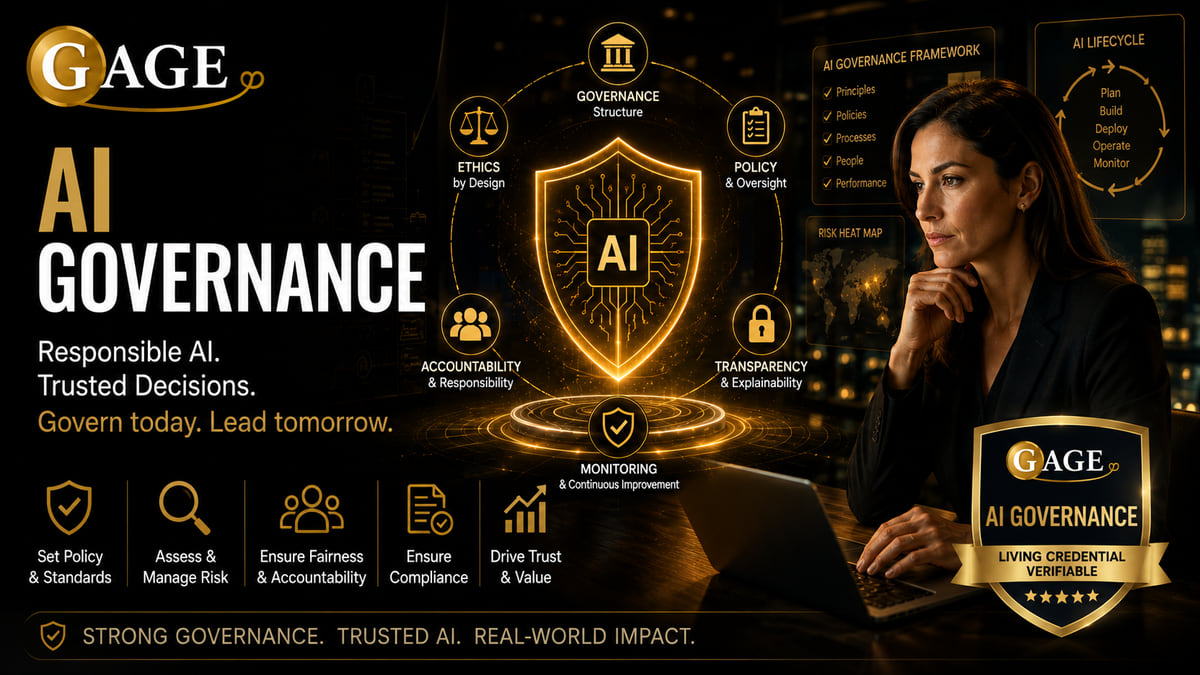
After completing this program, you will be able to:
Adversarial Governance
Your own governance file gets attacked, and you defend it. Exam prep certifies what you know; an adversarial defense proves what you can hold.
Who this is for
Your board has told you that you own AI now. The first modules give you the inventory, the risk register and the classification calls in the order a regulator asks for them.
You already read obligations for a living. This adds the AI specific work and a record of it, so a hiring manager sees evidence rather than a course title.
You do not have to build the file, you have to know when it is weak. The adversarial module is where you find that out with nobody watching.
You leave with the artifacts and the defense of them, which is what a client is paying for when they hire judgment.
The credential you earn
Not a certificate of attendance. A living record of what you proved, at a permanent link an employer can open, read and question.

- ✓Every one of the 98 topics, with the score you earned on eachNobody has to take your word for which parts you actually passed.
- ✓A Mastery Score built from two halvesHalf earned topic by topic, each topic's check and teach-back averaged; half at the summit exam or capstone.
- ✓An employer can ask it questionsThe record answers from the topics you passed, and says so when something was not covered.
A real specimen with this program's real modules and topics. The learner and the scores are examples, labeled on the record itself.
Free tools and guides
Free to open, and useful on their own. The program teaches the judgment behind them.
Curriculum · 14 modules
- Why decisions, not information, will make you the expert
- Meet your systems: mapping the AI your own organization already runs
- Your command tools: the Briefcase, the professor, the dossier you will build
- The first decision: your 90-day AI priorities memo for your own organization (and why you will revise it in shame later)
- Train a model with your own hands and watch what it actually learns
- Where the bias came from: tracing a bad prediction to its data
- Fixing the model, breaking it again: why fixes are never free
- Prompts, context, and why the same model gives different companies different answers
- What a model cannot know: hallucination produced on demand, then caught
- The license to govern: explaining to a skeptic exactly how your model fails
- Auditing your own data: provenance, gaps, and quiet poison
- Consent archaeology: what this data was collected for versus what you want to do
- The retention decision: what you must keep, what you must destroy, and proving both
- Synthetic data: when it saves you and when it launders a bias
- Third-party data and the vendor claims you must verify yourself
- The provenance file: your data map an auditor could follow
- Scoping the deployment: what your organization actually needs versus what the demo showed
- Build, buy, or wrap: the decision framework with your organization's real budget
- The vendor interrogation: questions that expose what the sales deck hides
- Shipping the feature: rollout, monitoring, and the rollback you hope not to use
- The 2 a.m. incident: your system fails live, stakeholders are calling, run the response
- The post-incident review: what you missed, written without blaming the tool
- Telling the customer: the disclosure decision and the words you actually send
- The AI contract: the clauses that protect you when the vendor's model fails
- The First 48 Hours of an AI Incident
- Distrust is a skill: why demos convince and evals do not lie
- Building the eval suite that would have caught your Module 3 incident
- Red-teaming your own system: attacks a motivated user will find
- The trust boundary: what this system may decide alone and where a human signs
- Model drift: detecting the quiet degradation nobody reports
- The evaluation report: evidence that your trust levels are earned, not hoped
- Independent Challenge: The Second Line Reads the Model
- The Model Inventory and Tiering That Survives an Examiner
The executive map of the EU AI Act: what applies to your organization, when it bites, and the evidence it expects, executed into documents. When your role owns the full article-by-article implementation, the EU AI Act Implementation Expert program is the deep-dive companion.
- The two gates: is it an AI system, and does the Act apply to your organization at all
- Article 4 executed: the literacy program you must actually stand up, with evidence
- Risk classification: which of your organization's systems is high-risk and proving why
- The hiring-AI problem: bias audits, notices, and the law already watching hiring AI
- GPAI upstream: what your foundation-model vendor owes you and what you must verify yourself
- The conformity file: assembling the evidence for the system you shipped in Module 3
- Answering a regulator's letter: responding with documents, not assurances, anchored to real enforcement patterns
- The US mosaic: federal signals, state laws, and the agencies that already reach workplace AI
- NIST AI RMF as an operating system: mapping your organization onto govern, map, measure, manage
- ISO/IEC 42001: standing up an AI management system without drowning in it
- China, the UK, and the divergence problem: one product, three rulebooks
- Standards versus law: what certification buys you and what it never will
- The cross-border decision: where your organization may ship its AI feature, defended with citations
- The Singapore stack: voluntary on paper, adopted in practice
- MAS runs the hardest AI regime in APAC, and it has never been a law
- ASEAN is not one market: the regional HQ problem
- The one-document lab: one AI system, three regimes, zero duplicate work
- Evidence Standards for Policy Claims
- What changes when the AI acts instead of answers: the agent risk model
- Permissioning an agent: tools, budgets, and the actions it may never take alone
- The oversight pattern: human-in-the-loop, on-the-loop, and out-of-the-loop, chosen per task with reasons
- The agent audit trail: logging actions so you can reconstruct any decision it made
- You deploy an agent: scoping, containment, and the kill switch you test before launch
- The runaway afternoon: your agent misbehaves in a loop, contain it live
- Agent governance policy: the one-page rules for every agent your organization runs
- Map your agent policy to the world's first agentic framework
- The honest ROI: measuring what the AI actually changed at your organization, not what the vendor promised
- The cost nobody budgets: verification, oversight, and the supervision tax
- Build, buy, or kill: the quarterly portfolio review with real numbers
- Insuring the risk: what AI liability coverage exists, what it excludes, and what that tells you
- The hostile board: defending your AI budget to directors who interrupt
- The investment memo: one page that survives a CFO
- The Ten AI Clauses and What Each One Moves
- Continuity When the Model Goes Down
- The workforce map: which roles in your organization change, which grow, and which end
- The hard conversation: telling a 20-year employee their role is transforming, roleplayed until it is humane and clear
- Resistance is information: what the sales team's quiet refusal is telling you
- The literacy rollout: training 400 people who did not ask for this
- The union question, the works council, and consultation done right
- The change narrative: why we are doing this, in words a warehouse shift believes
- The Working Group That Outlives Its Founder
- Influence Without Authority: The Governance Analyst's Toolkit
- Evidence is designed, not gathered: building systems whose proof exists before anyone asks
- The logging architecture: what your organization's systems must record, for whom, for how long
- Model cards and system cards for your own systems, written so an outsider could act on them
- The DPIA and FRIA, run jointly: one assessment, two regimes, no duplicate work
- Who owns the output: IP, training-data provenance, and the liability chain when AI work goes wrong
- The evidence annex: wiring every artifact so the Module 13 audit finds a paper trail, not a scramble
- Designing a Control That Can Be Tested
- Operating-Effectiveness Testing: The Sample, the Exception, the Finding
- Your conformity file under attack: the red team finds what you missed
- Defending the file: the live challenge and the amendments you concede
- Attacking to learn: you red-team a governance file and discover how thin most are
- Incident forensics: reconstructing a failure from logs when memories disagree
- The whistleblower memo: what you do when the report is about your own project
- Governance that survives: rebuilding the file so the next attack finds less
- Reading the primary source: a model card, a system card, and what they do not say
- Reproducing a claim: testing a vendor benchmark yourself in an afternoon
- The weekly frontier hour: a sustainable practice for staying current for a career
- Separating signal from theater: which AI news changes your decisions and which is noise
- Your successor's briefing: documenting your organization's AI estate so command can transfer
- Assembling the dossier: every artifact, every decision, one evidence file
- The board inspection: the seven-seat AI board audits your organization end to end
- The viva: defending your command live against the examiner
- The handover: what you now know that no essay could have taught you, and where you take it
See the full curriculum for Certified AI Governance Professional (CAIGP): every module on one page, with what each one covers.
What a recruiter and your board see
A record instead of a claim: a permanent link listing every topic you passed with the score you earned, signed so an altered copy fails verification, and able to answer an employer’s questions only from what you actually passed. No outside body accredits GAGE and this page does not pretend one does. What it offers instead is evidence anyone can open in seconds and test, and the tests to put it through are published.
See the roles this leads to, and who is hiring for them this week · Judge the credential yourself
Every topic counted here is built. Create a free account to open the first module, and the rest unlock with access.
How mastery is proven
Completion is not the bar here. Every claim on your credential is earned through assessment, and your final Mastery Score is built from two halves. The first half is where the teach-back lives.
Every topic ends with a server-graded check: pass at 80% or the next topic stays shut. Where a topic’s own recording is loaded (98 of 98 today, and growing), it also ends with a teach-back: you explain the lesson in your own words and it is graded against that recording on four dimensions. A topic’s score is the average of what it asked of you, and the running average across topics is half of your Mastery Score.
Finish every topic and face the summit: a timed, open book final exam of scenario judgment (open book on purpose: we test judgment, not memory), or a rubric-graded capstone project you actually build.
Your credential lives at a permanent signed URL. Employers scan it, see every verified competency with real scores, and can ask it questions grounded in what you actually passed.
Scenario responses are graded on four dimensions no multiple-choice exam can measure:
One focused 30-minute session per topic on the required path. The depth (full read, audio, slides, infographic, prompts) is there when you want it, never forced.
Your passed explanations become part of your credential. An employer who scans it can read how you explained each topic, in your words, if you choose to share them. You own your work and the dossier is off until you turn it on.
What every topic gives you
The lesson, the vocabulary, the prompt library, the scenario and the assessment are on every topic. Video, slides and audio are added as each program is recorded, and a topic shows only the formats it actually has.
Built sourced, shipped verified
Every topic is researched against real, cited sources, then scanned for gaps, bias, hallucination, and outdated material before it ships. Every review pass is logged with evidence, so the quality bar is verifiable, not a claim. The content you learn from has been pressure-tested before it reaches you.
Create a free account and the first module is yours, with no card. Your progress is saved and it is the same account your credential is issued to.
Frequently Asked Questions
Two separate programs, two different chairs, and most people need to know which one they are. This is command of the models: the risk register, vendor assessment, classification against the rulebooks, incident command and adversarial defense. AI Data Governance is command of the data those models eat. Neither is a version of the other, and the Governance Pair exists for the person who needs both.
The person accountable. The program assumes you will have to defend a decision to a board, a regulator or opposing counsel, which is why it ends in adversarial governance where someone competent tries to break your program, and why you leave with a dossier of decisions rather than a certificate.
The AIGP certifies that you know AI governance, through a proctored multiple choice exam. This program certifies that you can run it: you build the artifacts, defend them under review, and every topic you pass is written into a signed record an employer can open and question. People who hold both put the AIGP on the line above and this record underneath it, because one says you speak the language and the other shows the work. The full comparison, domain by domain, is on the page called After the AIGP. AIGP is a certification of the IAPP, which is not affiliated with GAGE.
No. The program adapts to your role: executive, technical, legal, clinical, or any other.
No. The grader reads for understanding, not for writing. Spelling, grammar and typing mistakes are never counted against you, and plain words that show you really understood the lesson score higher than polished sentences that only repeat its terms. If typing in English is the harder part, you can speak your explanation instead.
Every topic is researched against real sources and checked for gaps, bias, hallucination, and outdated material before it ships. When the rules move, the content moves with them.
A completion record with your assessment score. Pass every core topic and the program mastery exam to earn your signed GAGE credential: a living record anyone can verify in seconds by scanning its QR seal. Bonus tracks add visible evidence but never gate the credential.
They stack; they do not repeat. This program's EU AI Act module is the governance leader's executive map of the Act. The EU AI Act Implementation Expert program is the implementer's deep dive at 64-topic depth: classification, the technical file, conformity, CE marking, and the audit-ready portfolio. Run governance from this program; add the Expert program when you own the implementation itself.
Many certification bodies accept self-reported outside training: IAPP members, for example, can self-report relevant non-IAPP training at 1 CPE per hour of study, validated by proof of completion or an assessment, within 90 days of the activity. Your GAGE credential is built for exactly that kind of proof: it records the program and every mastery assessment you passed, with scores, at a link your certifying body can open. Check your own body's policy before relying on it.