Proven, not attended
Senior AI Scam Defense
You will not just learn about scams. You will leave protected.
For seniors, and for the families who look out for them.
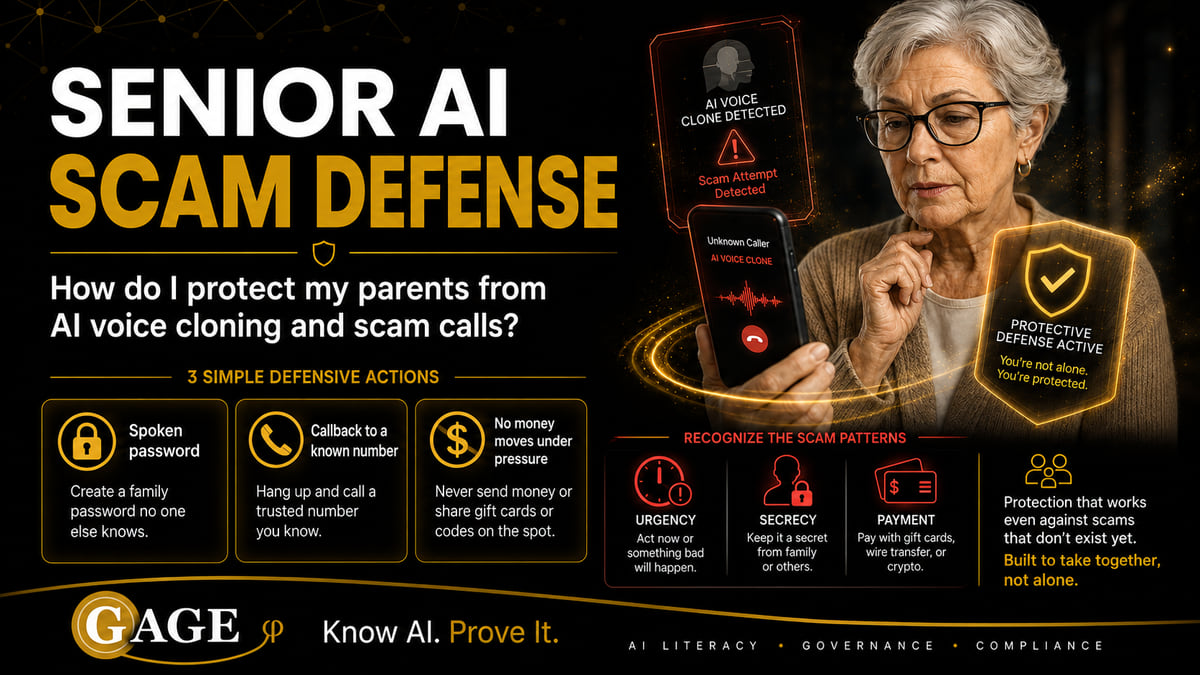
How do I protect my parents from AI voice cloning and scam calls?
Start with a spoken password agreed in person and never written down anywhere, because voice cloning defeats recognition and the defense cannot rely on recognizing the voice. Then a rule that no money moves without a callback to a number you already had. This program teaches the behavioral core underneath every one of these attacks, urgency, secrecy and a payment at the end, so it works against scam families that do not exist yet, and it is written to be taken together by two people rather than alone.
You start here, free, with no card: The eight rails and which ones give money back
After completing this program, you will be able to:
The Behavioral Core
The shape every one of these attacks shares, taught so it defeats scam families that do not exist yet. Everyone else lists this month's scams; this teaches the pattern underneath them.
The credential you earn
Not a certificate of attendance. A living record of what you proved, at a permanent link you can share with anyone who needs to check it.

- ✓Every one of the 109 topics, with the score you earned on eachNobody has to take your word for which parts you actually passed.
- ✓A Mastery Score built from two halvesHalf earned topic by topic, each topic's check and teach-back averaged; half at the summit exam or capstone.
- ✓Anyone you share it with can ask it questionsThe record answers from the topics you passed, and says so when something was not covered.
A real specimen with this program's real modules and topics. The learner and the scores are examples, labeled on the record itself.
Free tools and guides
Free to open, and useful on their own. The program teaches the judgment behind them.
Curriculum · 13 modules
8 topics in this module.
8 topics in this module.
11 topics in this module.
7 topics in this module.
10 topics in this module.
7 topics in this module.
13 topics in this module.
8 topics in this module.
7 topics in this module.
7 topics in this module.
8 topics in this module.
7 topics in this module.
8 topics in this module.
See the full curriculum for Senior AI Scam Defense: every module on one page, with what each one covers.
Every topic counted here is built. Create a free account to open the first module, and the rest unlock with access.
How mastery is proven
Completion is not the bar here. Every claim on your credential is earned through assessment, and your final Mastery Score is built from two halves. The first half is where the teach-back lives.
Every topic ends with a server-graded check: pass at 80% or the next topic stays shut. Where a topic’s own recording is loaded (6 of 109 today, and growing), it also ends with a teach-back: you explain the lesson in your own words and it is graded against that recording on four dimensions. A topic’s score is the average of what it asked of you, and the running average across topics is half of your Mastery Score.
Finish every topic and face the summit: a timed, open book final exam of scenario judgment (open book on purpose: we test judgment, not memory), or a rubric-graded capstone project you actually build.
Your credential lives at a permanent signed URL. Employers scan it, see every verified competency with real scores, and can ask it questions grounded in what you actually passed.
Scenario responses are graded on four dimensions no multiple-choice exam can measure:
One focused 30-minute session per topic on the required path. The depth (full read, audio, slides, infographic, prompts) is there when you want it, never forced.
Your passed explanations become part of your credential. An employer who scans it can read how you explained each topic, in your words, if you choose to share them. You own your work and the dossier is off until you turn it on.
What every topic gives you
The lesson, the vocabulary, the prompt library, the scenario and the assessment are on every topic. Video, slides and audio are added as each program is recorded, and a topic shows only the formats it actually has.
Built sourced, shipped verified
Every topic is researched against real, cited sources, then scanned for gaps, bias, hallucination, and outdated material before it ships. Every review pass is logged with evidence, so the quality bar is verifiable, not a claim. The content you learn from has been pressure-tested before it reaches you.
Create a free account and the first module is yours, with no card. Your progress is saved and it is the same account your credential is issued to.
Frequently Asked Questions
Yes. It runs in the web browser on a phone, a tablet or a computer, with nothing to install. Where she stops is where she starts again, on any of them, because the progress belongs to the account and not to the device.
One topic is one sitting, and the first one is free to read with no account at all. You can do the first one together this evening and stop there. No topic is timed and nothing expires.
Both, and it is written to be taken together. The behavioral core, the money rails and the trusted person modules all work better with two people than one, because the whole design of these scams is to get someone deciding alone and in a hurry.
That is what the behavioral core is for. It teaches the shape every one of these attacks shares, urgency, secrecy and a payment at the end, so it defeats scam families that do not exist yet. The specific-scam modules are updated as the tactics move.
No. The hardening lab walks through each setting one at a time, and the demystification lab explains what the technology actually is so it stops being frightening. Nothing assumes prior knowledge.
No. The program adapts to your role: executive, technical, legal, clinical, or any other.
No. The grader reads for understanding, not for writing. Spelling, grammar and typing mistakes are never counted against you, and plain words that show you really understood the lesson score higher than polished sentences that only repeat its terms. If typing in English is the harder part, you can speak your explanation instead.
Every topic is researched against real sources and checked for gaps, bias, hallucination, and outdated material before it ships. When the rules move, the content moves with them.
A completion record with your assessment score. Pass every core topic and the program mastery exam to earn your signed GAGE credential: a living record anyone can verify in seconds by scanning its QR seal. Bonus tracks add visible evidence but never gate the credential.
Many certification bodies accept self-reported outside training: IAPP members, for example, can self-report relevant non-IAPP training at 1 CPE per hour of study, validated by proof of completion or an assessment, within 90 days of the activity. Your GAGE credential is built for exactly that kind of proof: it records the program and every mastery assessment you passed, with scores, at a link your certifying body can open. Check your own body's policy before relying on it.