Proven, not attended
Certified Agentic AI Governance Professional (CAAGP)
You will not study agentic AI governance. You will deploy an agent under the first comprehensive national governance framework for agentic AI (IMDA's Model AI Governance Framework for Agentic AI v1.5, launched at Davos in January 2026) and defend that deployment against red-team review.
For anyone deploying or approving AI agents that act on their own: product, security, risk.
How do you govern AI agents that take actions on their own?
The questions change the moment a system acts rather than answers: what may it do, how far may it go, where must it stop, and who answers when it does something nobody instructed. Model governance does not cover any of that. This program is built on bounding by design, meaningful human accountability, threat modeling and red-teaming before release, monitoring a live agent, and the failures that only appear when several agents affect each other. It ends with you deploying an agent and defending that deployment.
You start here, free, with no card: Welcome to Applied Conformance
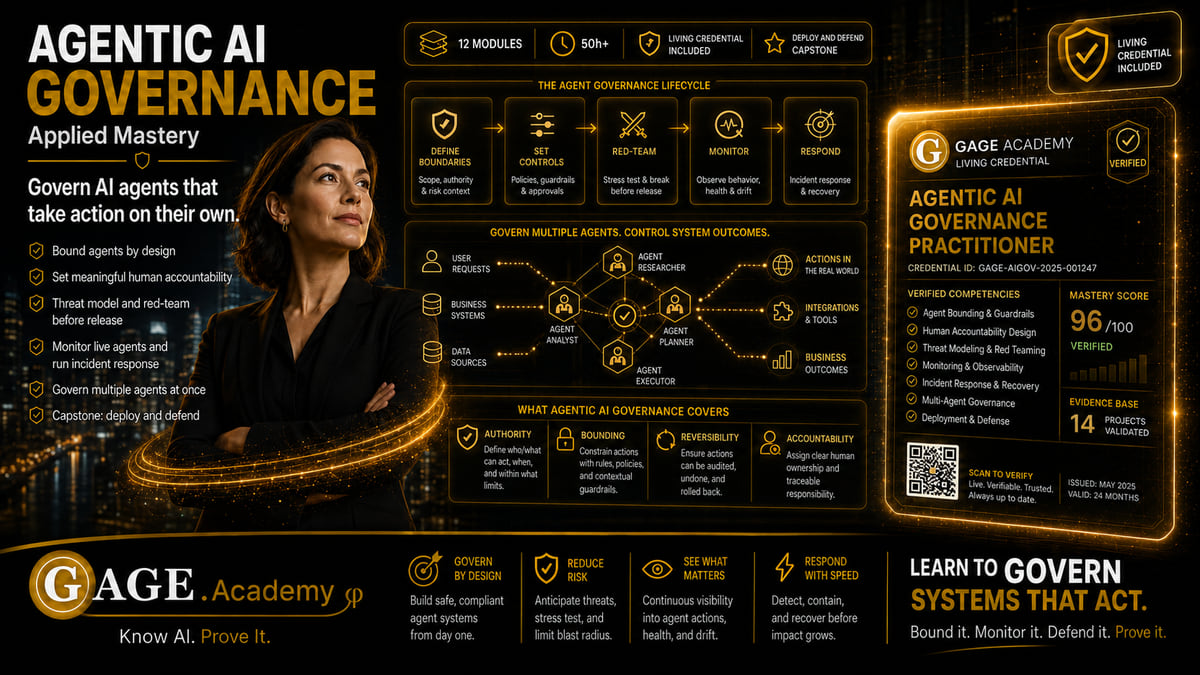
After completing this program, you will be able to:
The Capstone: Deploy and Defend
You deploy an agent under a real governance framework and then defend that deployment. Everyone else teaches agent risk as a reading list; this ends with a decision you have to stand behind.
The credential you earn
Not a certificate of attendance. A living record of what you proved, at a permanent link an employer can open, read and question.

- ✓Every one of the 100 topics, with the score you earned on eachNobody has to take your word for which parts you actually passed.
- ✓A Mastery Score built from two halvesHalf earned topic by topic, each topic's check and teach-back averaged; half at the summit exam or capstone.
- ✓An employer can ask it questionsThe record answers from the topics you passed, and says so when something was not covered.
A real specimen with this program's real modules and topics. The learner and the scores are examples, labeled on the record itself.
Curriculum · 12 modules
7 topics in this module.
9 topics in this module.
8 topics in this module.
8 topics in this module.
8 topics in this module.
9 topics in this module.
8 topics in this module.
10 topics in this module.
8 topics in this module.
8 topics in this module.
9 topics in this module.
8 topics in this module.
See the full curriculum for Certified Agentic AI Governance Professional (CAAGP): every module on one page, with what each one covers.
What a recruiter and your board see
A record instead of a claim: a permanent link listing every topic you passed with the score you earned, signed so an altered copy fails verification, and able to answer an employer’s questions only from what you actually passed. No outside body accredits GAGE and this page does not pretend one does. What it offers instead is evidence anyone can open in seconds and test, and the tests to put it through are published.
See the roles this leads to, and who is hiring for them this week · Judge the credential yourself
Every topic counted here is built. Create a free account to open the first module, and the rest unlock with access.
How mastery is proven
Completion is not the bar here. Every claim on your credential is earned through assessment, and your final Mastery Score is built from two halves. The first half is where the teach-back lives.
Every topic ends with a server-graded check: pass at 80% or the next topic stays shut. Where a topic’s own recording is loaded (7 of 100 today, and growing), it also ends with a teach-back: you explain the lesson in your own words and it is graded against that recording on four dimensions. A topic’s score is the average of what it asked of you, and the running average across topics is half of your Mastery Score.
Finish every topic and face the summit: a timed, open book final exam of scenario judgment (open book on purpose: we test judgment, not memory), or a rubric-graded capstone project you actually build.
Your credential lives at a permanent signed URL. Employers scan it, see every verified competency with real scores, and can ask it questions grounded in what you actually passed.
Scenario responses are graded on four dimensions no multiple-choice exam can measure:
One focused 30-minute session per topic on the required path. The depth (full read, audio, slides, infographic, prompts) is there when you want it, never forced.
Your passed explanations become part of your credential. An employer who scans it can read how you explained each topic, in your words, if you choose to share them. You own your work and the dossier is off until you turn it on.
What every topic gives you
The lesson, the vocabulary, the prompt library, the scenario and the assessment are on every topic. Video, slides and audio are added as each program is recorded, and a topic shows only the formats it actually has.
Built sourced, shipped verified
Every topic is researched against real, cited sources, then scanned for gaps, bias, hallucination, and outdated material before it ships. Every review pass is logged with evidence, so the quality bar is verifiable, not a claim. The content you learn from has been pressure-tested before it reaches you.
Create a free account and the first module is yours, with no card. Your progress is saved and it is the same account your credential is issued to.
Frequently Asked Questions
They are separate programs and this one assumes the other's subject rather than repeating it. AI Governance is about systems that produce output. This is about systems that take actions, where the questions are authority, bounding, reversibility and who answers when an agent does something nobody instructed. The capstone is deploying an agent and defending that deployment.
No, and the threat modeling and red-teaming modules do not assume you will write the code. They assume you will decide what an agent may do, set the bounds, and be able to challenge the people who built it. That is a judgment role, and the program is built for the person holding it.
The AIGP certifies that you know AI governance, through a proctored multiple choice exam. This program certifies that you can run it: you build the artifacts, defend them under review, and every topic you pass is written into a signed record an employer can open and question. People who hold both put the AIGP on the line above and this record underneath it, because one says you speak the language and the other shows the work. The full comparison, domain by domain, is on the page called After the AIGP. AIGP is a certification of the IAPP, which is not affiliated with GAGE.
No. The program adapts to your role: executive, technical, legal, clinical, or any other.
No. The grader reads for understanding, not for writing. Spelling, grammar and typing mistakes are never counted against you, and plain words that show you really understood the lesson score higher than polished sentences that only repeat its terms. If typing in English is the harder part, you can speak your explanation instead.
Every topic is researched against real sources and checked for gaps, bias, hallucination, and outdated material before it ships. When the rules move, the content moves with them.
A completion record with your assessment score. Pass every core topic and the program mastery exam to earn your signed GAGE credential: a living record anyone can verify in seconds by scanning its QR seal. Bonus tracks add visible evidence but never gate the credential.
Many certification bodies accept self-reported outside training: IAPP members, for example, can self-report relevant non-IAPP training at 1 CPE per hour of study, validated by proof of completion or an assessment, within 90 days of the activity. Your GAGE credential is built for exactly that kind of proof: it records the program and every mastery assessment you passed, with scores, at a link your certifying body can open. Check your own body's policy before relying on it.